This post may contain affiliate links and ads in which we may earn a small percentage of purchases.
In Traditional Chinese Medicine, “Essence” (also known as Jing) is considered the material foundation of the human body and many of its functional activities.
Quick Links
What is Essence in Traditional Chinese Medicine and Why Does It Matter?
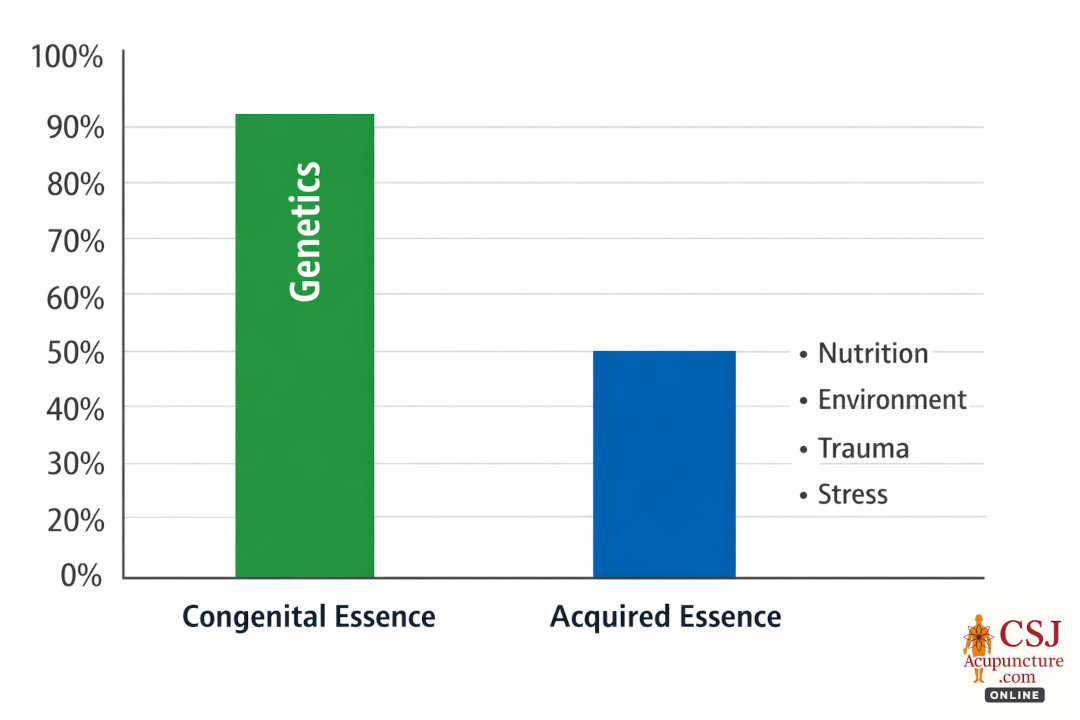
Kidney essence is divided into two forms: congenital essence and acquired essence.
Congenital essence is inherited from the parents before birth. It provides the original material basis for life and development. Acquired essence, by contrast, is produced after birth from the essential substances of food and drink through the transforming and transporting functions of the spleen and stomach.
These two forms of essence support one another. Before birth, congenital essence provides the foundation for life. After birth, acquired essence continually nourishes and replenishes congenital essence. Although both are important, acquired essence is often emphasized because it helps sustain the body throughout life.
The kidney’s role in growth, reproduction, and development depends on kidney qi. In other words, the body’s ability to mature, reproduce, and maintain vitality is closely tied to the strength or decline of the essential qi of the kidneys.
During childhood, kidney essence gradually develops and becomes evident in the growth of the body, as well as changes in the skin and hair. In adolescence, kidney essence flourishes. At this stage, sexual maturation appears, with seminal emission in males and the onset of menstruation in females, reflecting the development of reproductive function.
As a person ages, kidney essence gradually declines. With this decline, reproductive ability and sexual function diminish, and the body begins to weaken and wither.
Kidney Essence and Modern Physiology
While kidney essence is rooted in Traditional Chinese Medicine theory, many of its functions can be understood through modern concepts in biology and physiology. Rather than representing a single structure, kidney essence reflects a combination of systems that govern growth, development, reproduction, and long-term vitality.
Congenital Essence and Genetics
Congenital essence can be compared to the body’s genetic foundation. It is inherited from the parents and establishes the blueprint for development before birth. In modern terms, this aligns with DNA, genetic expression, and prenatal development.

This foundation influences growth potential, resilience, and susceptibility to certain conditions. Just as TCM describes congenital essence as fixed at birth, genetics provides the baseline from which the body develops. For a deeper look at how Traditional Chinese Medicine relates to genetics, see our article on genetics and TCM.
Acquired Essence and Metabolism
Acquired essence is formed after birth through the digestion and transformation of food. This closely relates to the gastrointestinal system and metabolism in modern physiology.
Through digestion and absorption, nutrients are converted into usable energy and building materials for the body. This includes processes such as ATP production, protein synthesis, and cellular repair. In this way, acquired essence represents the body’s ability to maintain and replenish itself through proper nutrition and efficient metabolic function.
Kidney Essence and the Endocrine System
Many of the functions attributed to kidney essence align with the endocrine system, particularly hormonal regulation.
This includes the activity of systems such as the hypothalamic-pituitary-gonadal axis, which governs reproductive hormones and puberty, and the hypothalamic-pituitary-adrenal axis, which plays a role in stress response and long-term energy regulation.
Hormones such as estrogen, testosterone, and growth hormone are central to development, fertility, and aging. This provides a physiological basis for the TCM concept that kidney essence governs reproduction, growth, and maturation.
Growth, Development, and Aging
The stages described in TCM closely mirror biological development. In childhood, growth and development are driven by nutrition and hormonal signaling. During adolescence, reproductive maturity is reached through hormonal changes. In adulthood, the body maintains peak function, followed by a gradual decline over time.
From a biomedical perspective, aging involves processes such as hormonal decline, reduced cellular regeneration, and changes in metabolic efficiency. These changes parallel the TCM concept of the gradual depletion of kidney essence.
Kidney Essence as a Functional Reserve
A practical way to understand kidney essence is as the body’s long-term reserve capacity. This includes the ability to grow, repair, reproduce, and adapt to stress over time.
In modern terms, this may involve factors such as hormonal balance, regenerative potential, and overall physiological resilience. When this reserve is strong, the body tends to recover efficiently and maintain vitality. When it is weakened, signs such as fatigue, reduced reproductive function, and accelerated aging may appear.
Clinical Perspective
Kidney essence can be viewed as a systems-level concept that integrates genetics, metabolism, endocrine function, and aging. While it does not correspond to a single anatomical structure, it provides a useful framework for understanding long-term health and development.
By maintaining proper nutrition, managing stress, and supporting overall health, it is possible to preserve and optimize this functional reserve over time.
Medical Disclaimer: This article is for informational and educational purposes only and is not a substitute for professional medical advice, diagnosis, or treatment. Always consult a qualified healthcare provider with any questions about a medical condition or treatment.