
This post may contain affiliate links and ads in which we may earn a small percentage of purchases.
Gallbladder 30 (GB 30) is an important point especially in conditions such as sciatica.
Quick Links
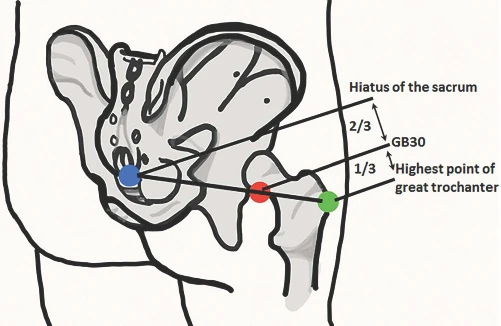
GB 30 Acupuncture Point Location
At the junction of the lateral 1 and 1/3rd and medial 2 and 1/3rd of the distance between
the great trochanter and the hiatus of the sacrum.1
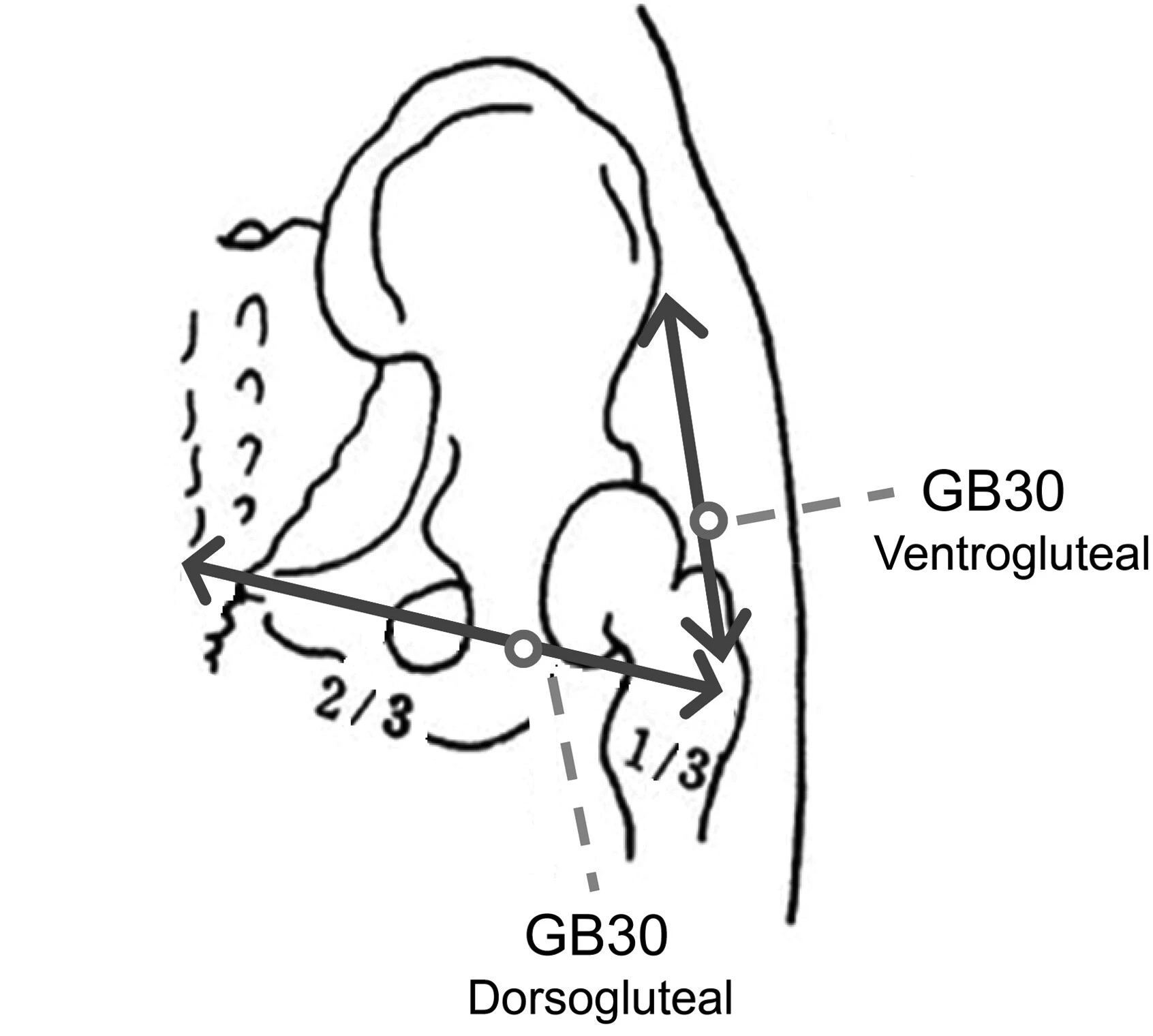
Bio-anatomical research comparing dorsogluteal and ventrogluteal regions highlights the importance of accurate landmarking in the gluteal area due to proximity to the sciatic nerve.2 This reinforces the need for precise anatomical knowledge when needling GB30, as the point lies in the posterior gluteal region near major neural structures.
GB 30 Functions:
Hip pain
A stainless-steel acupuncture pen and gua sha set.
 View Product
Sciatica
Low back pain
Muscular atrophy
Anxiety for pain3
Clinical Application of GB30 (Huantiao)
Primary Clinical Uses
GB30 is one of the primary points I rely on clinically for conditions involving sciatica or sciatica-like symptoms. When patients present with pain that radiates from the hip into the leg, this point is often central to the treatment strategy. It is also highly effective for general hip joint pain and has proven useful in post-procedural care, including rehabilitation support following hip replacement surgery. In these cases, GB30 helps address deep muscular tension and improves functional movement around the hip.
Needling Technique and Stimulation
From a needling standpoint, GB30 requires proper positioning and technique. The point can be accessed with the patient either lying face down or on their side, depending on comfort and clinical context. Because the gluteal region contains thick, dense muscle tissue, superficial needling is usually insufficient. The needle must be inserted deep enough to pass through the muscle layer in order to effectively stimulate the point and produce meaningful results.
When appropriate, GB30 responds exceptionally well to electro-acupuncture. Electro-stimulation can enhance neural activation, increase local circulation, and improve overall treatment effectiveness, particularly in chronic or severe presentations.
Point Combinations and Clinical Pairings
Clinically, GB30 works best when it is not used in isolation. I often combine it with Urinary Bladder 25 when low back or sacral pain is present, as this pairing addresses both the source and the pathway of discomfort. Distal points such as UB40, UB38, UB39, UB57, and Kidney 3 are also commonly included to support the entire channel system and reinforce treatment effects.
While GB30 may be used in certain bladder-related presentations, its primary role in this context is musculoskeletal and neurological pain management.
Physiological and Therapeutic Goals
From a physiological perspective, the primary goal of using GB30 is to reduce strain on the sciatic nerve. Treatment focuses on restoring proper nerve communication and improving blood flow to the affected area. Nerves require both adequate circulation and freedom from excessive tension to function properly. By releasing deep muscular restriction in the gluteal region, GB30 helps create an environment that supports nerve recovery and pain reduction.
Patient Comfort, Draping, and Clinical Ethics
Because of its location, GB30 requires thoughtful patient management and strict attention to professional boundaries. The gluteal region is a sensitive area, and proper draping is essential to ensure patient comfort and modesty. In clinical practice, I recommend using two gowns so that only the precise area needed for needling is exposed while the rest of the body remains covered.
This approach maintains professionalism, builds trust, and allows the practitioner to work effectively without compromising patient comfort.
Research on GB 30
Acupuncture at GB30 and GB34 Supports Nerve Repair in Rats Study
Peripheral nerve injuries (PNI) are common in clinical settings. While they are usually not life-threatening, they can cause serious problems such as muscle weakness, numbness, poor coordination, and even muscle wasting in the affected limb. Injuries to the sciatic nerve, in particular, can significantly impair walking and lower-body function.
In an experimental study using a mouse model of sciatic nerve injury, researchers investigated whether acupuncture at Huantiao (GB30) and Yanglingquan (GB34) could promote nerve repair.
After creating a controlled sciatic nerve injury in mice, researchers applied acupuncture at GB30 and GB34 over a two-week period. They then measured recovery using several methods, including gait analysis (to evaluate walking ability),toe spreading tests, electrophysiological testing (to measure nerve signal transmission), and tissue staining to examine nerve structure and regeneration.
The researchers also analyzed biological markers associated with nerve repair and recovery, including MBP, NF200, p75NTR, and GAP43 – proteins that play key roles in nerve growth and structural restoration.
The acupuncture-treated group showed significantly better recovery compared to untreated animals, specifically4:
- Improved walking patterns
- Better toe spreading and motor control
- Stronger nerve signal conduction
- Increased numbers of healthy, myelinated nerve fibers
- Higher expression of proteins associated with nerve regeneration
In short, acupuncture at GB30 and GB34 promoted both functional recovery (movement and nerve signaling) and structural recovery (actual nerve fiber regeneration).
Although this study was conducted in animals, it provides biological insight into what many practitioners observe clinically. GB30 is frequently used in cases involving sciatica and nerve-related pain. This research supports the idea that stimulation at GB30 may influence more than just pain perception—it may also create conditions that support nerve repair and regeneration.
For practitioners, this strengthens the clinical rationale behind selecting GB30 and GB34 in cases involving sciatic nerve involvement and peripheral nerve dysfunction.
GB30 For Pain and Anxiety
Chronic pain does not affect the body alone. It often affects emotional health as well. In humans, persistent pain is commonly associated with anxiety, fear, depression, and emotional distress. In many cases, these emotional symptoms can be just as disruptive as the physical pain itself.
Researchers explored whether stimulating Huantiao (GB30) could reduce both neuropathic pain and pain-related anxiety in an experimental rat model.
The study focused on a brain region called the anterior cingulate cortex (ACC). This area plays a major role in processing the emotional component of pain. The researchers specifically examined a protein called p-ERK, which is known to increase in the ACC during pain-induced anxiety.
Male rats were divided into several groups:
- Control group
- Neuropathic pain group (SNL model)
- Strong manual acupuncture (sMA) group
- Mild manual acupuncture (mMA) group
- Electroacupuncture (EA) group
Both sides of GB30 were stimulated using different acupuncture techniques.
Results of the study where as follows5:
- Strong manual acupuncture and electroacupuncture both increased pain thresholds, meaning the animals became less sensitive to pain.
- Strong and mild manual acupuncture improved anxiety-like behaviors.
- Elevated levels of p-ERK in the anterior cingulate cortex—associated with pain-induced anxiety—were reduced after acupuncture treatment.
In simple terms, stimulating GB30 not only reduced physical pain but also helped regulate the brain activity linked to the emotional distress caused by that pain.
- Cheng X. Chinese Acupuncture and Moxibustion. Beijing, China: Foreign Languages Press; 1987:207. ↩︎
- Zhou W, Longhurst JC. Neuroendocrine mechanisms of acupuncture in the treatment of pain and related anxiety disorders. Med Acupunct. 2015;27(6):411-418. doi:10.1089/acu.2015.1107 ↩︎
- Shao XM, Shen Z, Sun J, Fang F, Fang JF, Wu YY, Fang JQ. Strong manual acupuncture stimulation of “Huantiao” (GB 30) reduces pain-induced anxiety and p-ERK in the anterior cingulate cortex in a rat model of neuropathic pain. Evid Based Complement Alternat Med. 2015;2015:235491. doi:10.1155/2015/235491 ↩︎
- Ji Q, Shan F, Zhang B, Chen Y, Yang X, Gao F, Li X. Acupuncture on “Huantiao” (GB30) and “Yanglingquan” (GB34) acupoints promotes nerve regeneration in mice model of peripheral nerve injury. IBRO Neurosci Rep. 2023;15:158-164. doi:10.1016/j.ibneur.2023.08.004 ↩︎
- Shao XM, Shen Z, Sun J, Fang F, Fang JF, Wu YY, Fang JQ. Strong manual acupuncture stimulation of “Huantiao” (GB 30) reduces pain-induced anxiety and p-ERK in the anterior cingulate cortex in a rat model of neuropathic pain. Evid Based Complement Alternat Med. 2015;2015:235491. doi:10.1155/2015/235491 ↩︎
Medical Disclaimer: This article is for informational and educational purposes only and is not a substitute for professional medical advice, diagnosis, or treatment. Always consult a qualified healthcare provider with any questions about a medical condition or treatment.


